Your Dashboard Tells You What's So. It's Never Told You So What.
Kana co-founder Vivek Vaidya's Ai4 2026 talk made the case for agentic marketing: not another point solution, but an operating layer.

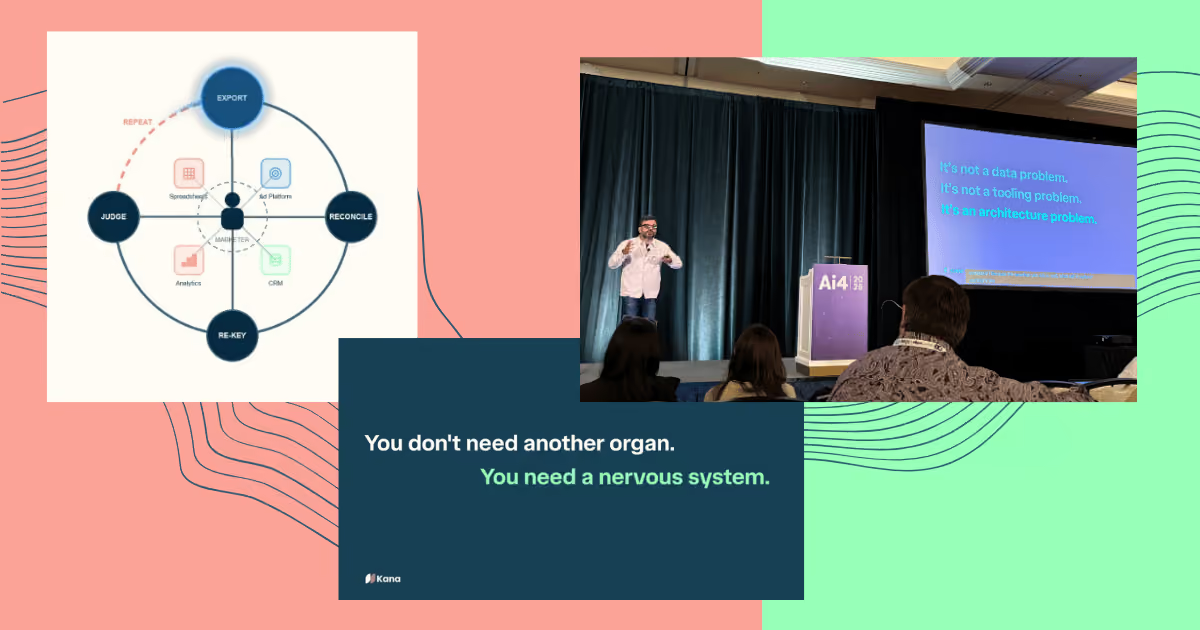
Last week at Ai4 2026 in Las Vegas, Kana co-founder and CTO Vivek Vaidya took the Growth and Marketing track stage with a 20-minute talk aimed squarely at a room full of builders: "Your Martech Stack Doesn't Need Another Dashboard. It Needs a Nervous System." In this post we’re recapping the high points from his presentation.
The numbers that opened the talk
Vivek opened with a number: 90. That’s the number of marketing cloud services the average enterprise marketing team now runs.
Then he widened the lens, discussing how the marketing technology (martech) landscape has gone from about 150 available solutions in 2011 to more than 15,000 today. It turns out the category hasn’t shrunk the problem. Rather, it has multiplied it, and despite all that tooling and all that data, campaign velocity and attribution haven't meaningfully improved in a decade which explains a lot of the frustration and disillusionment that both marketing and finance teams have experienced over the last 10 years. So what’s the real issue preventing progress? "The problem isn't a lack of data or tooling," Vivek said. "The problem is that your stack can see, but it can't think."
The diagnosis: organs without a nervous system
Here's our theory: the next frontier in martech isn't another point solution. It's a nervous system (a marketing operating layer) for a body that, until now, has only ever had organs (point solutions).
Every enterprise marketing team knows the narrative arc we're referring to here. A new technology promises to make the job easier. You adopt it, integrate it, build workflows around it and a few years later you're managing a dozen-plus platforms that don't talk to each other. The point Vivek made was that no single tool in that stack failed. What failed is that nobody built the connective tissue between them, so the marketer became the connective tissue, copying data by hand, and making judgment calls no tool was smart enough to make. "It's not a data problem. It's not a tooling problem. It's an architecture problem. Nobody designed the layer that makes the organs act as one body.”
“A dashboard,” he added, “tells you what's so. It has never told you ‘so, what?’ and it has never taken any action for you.”
Defining agentic marketing
Vivek collapsed the AI landscape into four levels the audience could hold onto:
- Rules-based automation: if/then logic, brittle, breaks on anything unanticipated.
- Predictive ML: scores and ranks, but doesn't act. It tells you someone will churn; you still build the intervention.
- LLMs, chatbots, copilots: prompt in, response out. Reactive, no memory, no execution across systems.
- AI agents: goal in; plan, execute, evaluate, adapt. Continuous, not conversational.
"A tool that generates content is not an agent," he said. "An agent acts, plans, and executes across systems."
From there, he defined the operating layer itself: a system of specialized, loosely coupled agents sharing one continuously learning knowledge layer and one policy layer, coordinating action across channels in real time. "Loosely coupled" was a deliberate word choice, as the model works with the tools already in the stack instead of ripping and replacing them. Because, again, the nervous system doesn't require new organs. It requires the wiring between the ones you already have.
He extended the point later in the talk with a second frame: model + chassis = an agent; agents + shared knowledge and policy = a nervous system. The model reasons, but the chassis around it (context, tools, memory, policy, and proof) decides what it can see, what it may touch, and whether you can trust the answer. "Enterprise-grade isn't a bigger model," he said. "It's a better chassis."
How to approach the transition — and the build/buy question underneath it
Vivek laid out a maturity path for teams making the shift, in order:
- On-demand agents first: well-defined, time-consuming tasks like report generation, audience building, and competitive research. Immediate time back, low risk.
- Continuous agents next: background monitoring against thresholds like spend anomalies, CPA drift, and engagement decay, acting without being asked.
- Autonomous agents last, and only once governance supports it: cross-functional outcomes pursued end-to-end with minimal direction.
Underneath that path sits a fork every buyer in the room is already wrestling with: build it yourself and inherit the engineering and maintenance burden forever; buy a generic point solution and accept the configuration tax; or find a model where you can build with a technology partner, so they can absorb the technical burden while you retain control of policy, tuning, and outcomes.
In closing, Vivek gave the audience one question to cut through vendor pitches: "When the underlying model changes, when a regulation shifts, when your data changes, whose job is it to keep this working?"
Missed the talk?
If you missed Ai4 and you’re just catching up now, the same evaluation lens applies: sense, decide, act, or just another dashboard? If you want to talk through where your own organization sits on the maturity path, reach out to discuss your path with our team.